Download
Checking the latest release on GitHub…
Each archive contains every plugin format for its platform. Files are served by GitHub from the project's releases.
There is no packaged release yet; the first one is still in the works. Until then you can watch the releases page, or build Gjalla from source with the instructions further down.
Releases on GitHubFeatures
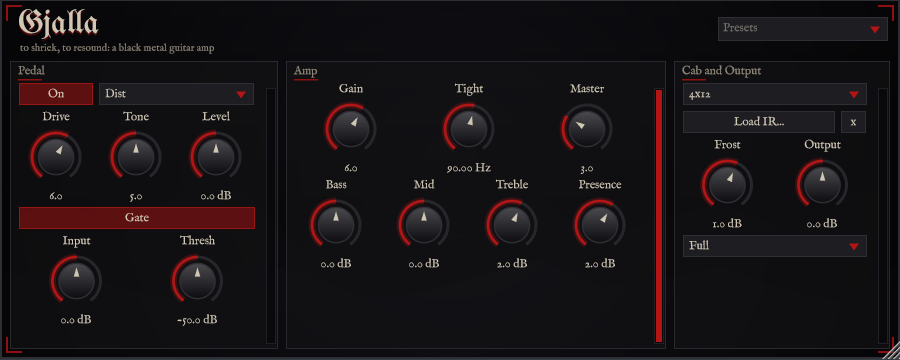
- One chain from dry guitar to finished tone, in signal order: input trim, noise gate, pedal, preamp, tone stack, power section, presence, cabinet, frost, output trim
- Noise gate on the clean signal ahead of every gain stage, with fixed 0.5 ms attack, 80 ms release and 4 dB of hysteresis, and no added latency
- Three pedal voicings sharing one set of knobs: a cheap 90s distortion box, an HM-2 style chainsaw and a starved transistor fuzz (details in the table below)
- Solid-state preamp: two cascaded gain-plus-waveshaper stages up to +36 dB, a sweepable 20-300 Hz tight filter ahead of the clipping, and a deliberate asymmetry that puts even harmonics in without leaving DC behind
- Three-band tone stack plus a presence control after the power section
- Three analytic cabinet voicings (4x12, practice combo, boombox), or load your own WAV/AIFF impulse response up to 2 seconds, or switch the cabinet off entirely for an external IR loader
- Frost: a tilt filter at 1 kHz that takes the amp from dark to thin
- 2x or 4x oversampling around the whole nonlinear path, 6 samples of latency (0.13 ms at 48 kHz) reported to the host and identical at both quality settings
- Level compensation on the pedal and the preamp, so drive and gain buy distortion rather than volume and Master stays the volume control
- Six factory presets, in/out level meters, right-click any knob to reset it or type a value, undo/redo (Ctrl+Z / Ctrl+Shift+Z)
- Dark GUI shared with Galdr and Gala, resizable 0.75x to 2x, with tooltips on every control
- Versioned session state: settings saved today keep loading in future versions
- No telemetry, no network access, no update checks, no accounts
The pedal knobs
The pedal has three knobs and three voicings, and each knob means something different per voicing:
| Dist | Chainsaw | Fuzz | |
|---|---|---|---|
| Reference | cheap 90s distortion box | HM-2 style | starved transistor fuzz |
| Drive | 0 to +40 dB into an asymmetric diode clipper | clip amount, 0 to +36 dB into a hard clipper | 0 to +50 dB into a lopsided hard clipper |
| Tone | tilt around 800 Hz, dark to thin | sweeps the upper of the two pre-clip peaks, 700 Hz to 1.5 kHz | post low-pass, 1 to 8 kHz |
| Level | output trim, -12 to +12 dB | output trim | output trim |
Dist high-passes at 60 Hz before clipping. Chainsaw pushes two fixed +9 dB peaks (250 Hz and the swept one) into the clipper and low-passes at 6 kHz afterwards, which is where the buzzsaw comes from. Fuzz clips harder on the positive rail than the negative one.
Installation
Extract the archive for your platform, copy each plugin into the folder below, then rescan your plugins in the DAW. The standalone app needs no installation and runs from wherever you put it.
| Format | Windows | macOS | Linux |
|---|---|---|---|
| VST3 | C:\Program Files\Common Files\VST3 |
~/Library/Audio/Plug-Ins/VST3 |
~/.vst3 |
| CLAP | C:\Program Files\Common Files\CLAP |
~/Library/Audio/Plug-Ins/CLAP |
~/.clap |
| AU | n/a | ~/Library/Audio/Plug-Ins/Components |
n/a |
| Standalone | run directly | run directly | run directly |
Building from source
You need git, CMake ≥ 3.22 and a C++20 compiler (Visual Studio 2022 on Windows, Xcode on macOS, GCC or Clang on Linux).
git clone --recurse-submodules https://github.com/andreademurtas/gjalla.git
cd gjalla
cmake -B build
cmake --build build --config Release
Builds end up in build/Gjalla_artefacts/Release/.
On Linux, install the JUCE build dependencies first; the package list is in the
README.
License
Gjalla is licensed under the GNU General Public License v3.0 or later.
It is built on the JUCE framework (AGPLv3),
uses the VST3 SDK interfaces distributed with JUCE (MIT), and
clap-juce-extensions
(MIT) for the CLAP build. Binary releases ship the relevant license
texts in a licenses/ folder plus a NOTICE.txt
with full attributions.
The GUI embeds UnifrakturMaguntia and IM Fell English, the same typefaces you are reading now, both under the SIL Open Font License.
