Download
Checking the latest release on GitHub…
Each archive contains every plugin format for its platform. Files are served by GitHub from the project's releases.
There is no packaged release yet; the first one is still in the works. Until then you can watch the releases page, or build Galdr from source with the instructions further down.
Releases on GitHubFeatures
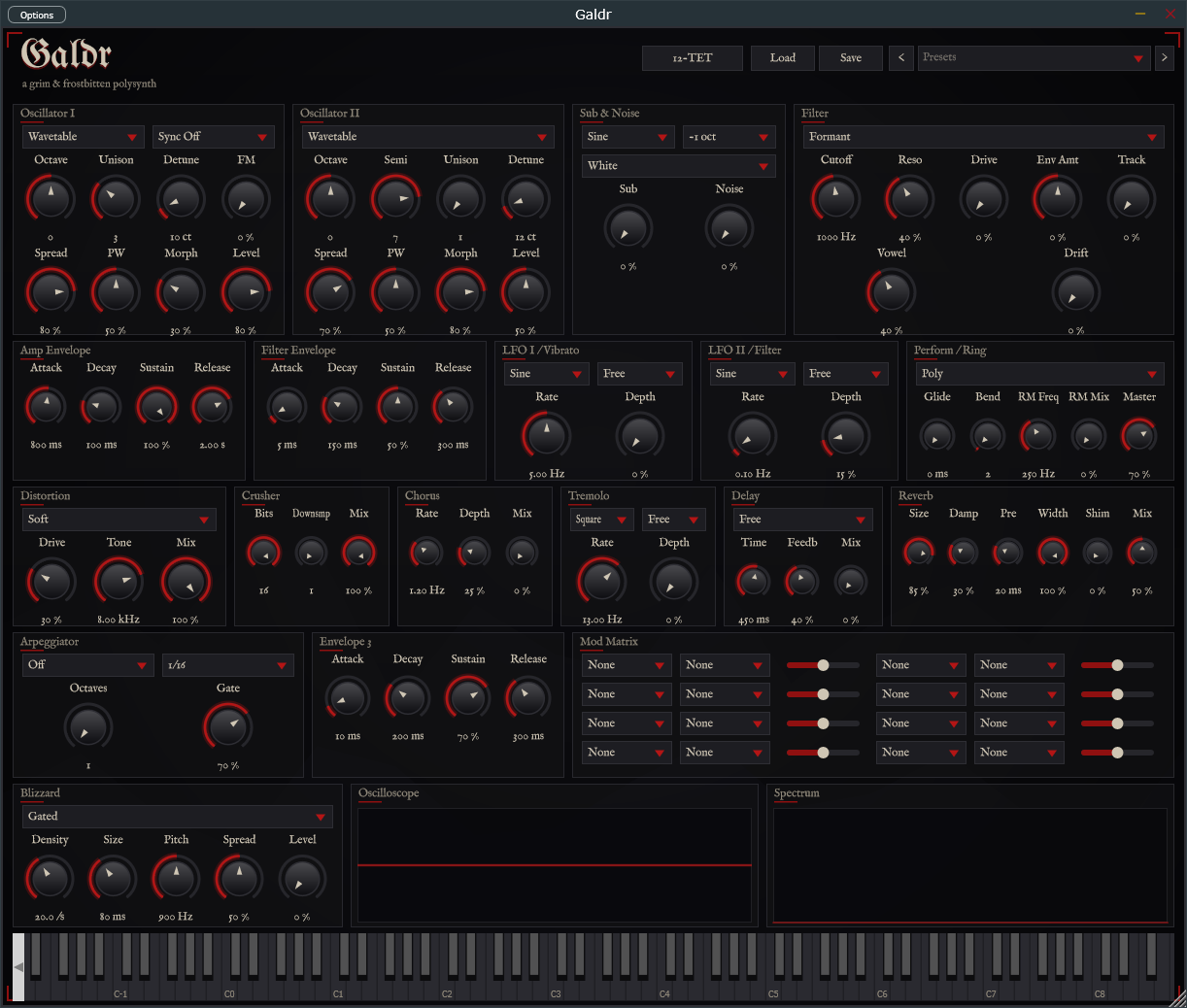
- 12-voice engine with poly, mono and legato modes
- Two band-limited (PolyBLEP) oscillators, up to 7-voice unison with detune and stereo spread, sub oscillator and white/pink noise
- FM (osc 2 modulates osc 1) and hard sync for aggressive metallic timbres, plus per-voice analog drift
- Morphing wavetable mode: 32 mip-mapped frames sweeping from sine through saw to an inharmonic “grim” spectrum
- Multimode filter (LP 12/24 dB, HP, BP and vowel formant) with drive, dedicated envelope and keytracking
- 8-slot modulation matrix (LFOs, envelopes, velocity, mod wheel, pressure, per-note random) routable to pitch, morph, cutoff, FM, FX sends and more, with a free third envelope
- Tempo-synced arpeggiator (up/down/up-down/random/as-played, up to 4 octaves)
- Two LFOs, glide, separate amp and filter envelopes
- MPE-friendly per-note pitch bend and pressure; Scala (.scl) microtuning
- Genre FX chain with the nonlinear stages oversampled 2×: four-flavour distortion, bitcrusher, ring modulator, chorus, tremolo picking, delay and a dark FDN cavern reverb with predelay and octave-up shimmer
- “Blizzard”: a granular snowstorm texture layer, gated by note activity or free-running as a continuous drone
- Tempo sync for LFOs, tremolo and delay (musical divisions of the host tempo)
- Preset browser with factory and user presets, oscilloscope and spectrum analyser, on-screen MIDI keyboard
- Dark-fantasy themed GUI, resizable, with tooltips
Installation
Extract the archive for your platform, copy each plugin into the folder below, then rescan your plugins in the DAW. The standalone app needs no installation and runs from wherever you put it.
| Format | Windows | macOS | Linux |
|---|---|---|---|
| VST3 | C:\Program Files\Common Files\VST3 |
~/Library/Audio/Plug-Ins/VST3 |
~/.vst3 |
| CLAP | C:\Program Files\Common Files\CLAP |
~/Library/Audio/Plug-Ins/CLAP |
~/.clap |
| AU | n/a | ~/Library/Audio/Plug-Ins/Components |
n/a |
| Standalone | run directly | run directly | run directly |
Building from source
You need git, CMake ≥ 3.22 and a C++20 compiler (Visual Studio 2022 on Windows, Xcode on macOS, GCC or Clang on Linux).
git clone --recurse-submodules https://github.com/andreademurtas/galdr.git
cd galdr
cmake -B build
cmake --build build --config Release
Builds end up in build/Galdr_artefacts/Release/.
On Linux, install the JUCE build dependencies first; the package list is in the
README.
License
Galdr is licensed under the GNU General Public License v3.0 or later.
It is built on the JUCE framework (AGPLv3),
uses the VST3 SDK interfaces distributed with JUCE (MIT), and
clap-juce-extensions
(MIT) for the CLAP build. Binary releases ship the relevant license
texts in a licenses/ folder plus a NOTICE.txt
with full attributions.
The GUI embeds UnifrakturMaguntia and IM Fell English, the same typefaces you are reading now, both under the SIL Open Font License.
